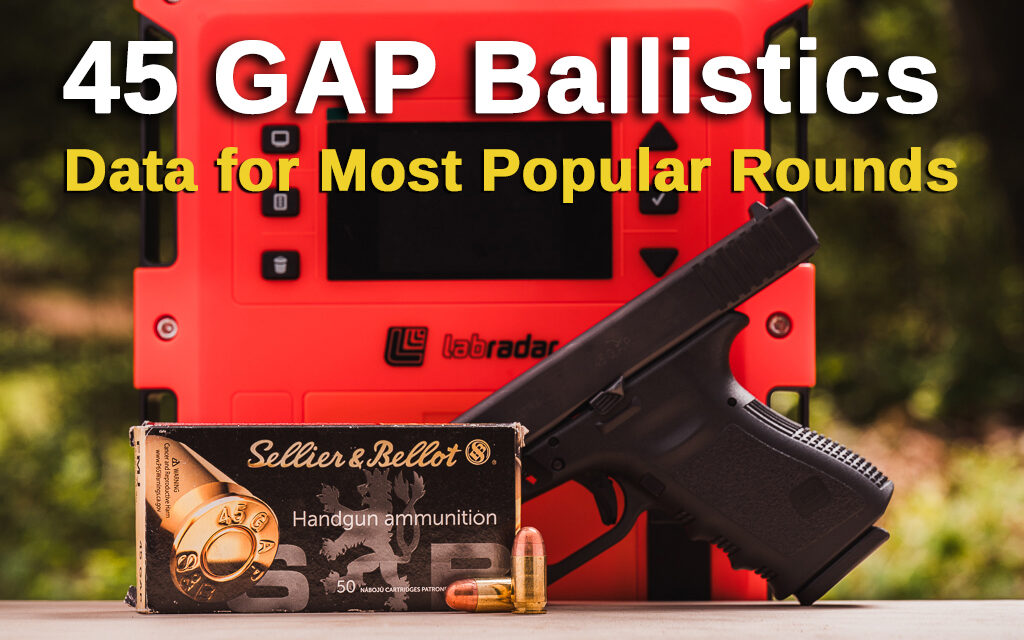
The most important thing to know about the 45 GAP is what it is not. It is not 45 ACP, and cannot function safely in a firearm chambered for the same.
45 GAP Ballistic Chart
Our team collected ballistic data from a multitude of popular ammunition manufacturers and assembled them in one handy point of reference. Please consult the notes below for more information on ballistic data and how we calculated ours.
Buffalo Bore
| Mfr / Brand | SKU | Bullet | G1 BC / Bbl (in) |
|---|---|---|---|
| Buffalo Bore | 38E/20 | 160gr TAC-XP | 0.133 / 4 |
| Range (yds) | Velocity (fps) | Energy (ft lbs) | Elevation (in) |
| 0 | 1146 | 467 | -0.2 |
| 25 | 1084 | 418 | 0.8 |
| 50 | 1034 | 380 | 0 |
| 75 | 993 | 350 | -2.8 |
| 100 | 958 | 326 | -7.9 |
| Buffalo Bore | 38A/20 | 185gr JHP | 0.109 / 4 |
| Range (yds) | Velocity (fps) | Energy (ft lbs) | Elevation (in) |
| 0 | 1050 | 453 | -0.2 |
| 25 | 997 | 409 | 1 |
| 50 | 954 | 374 | 0 |
| 75 | 917 | 346 | -3.4 |
| 100 | 884 | 321 | -9.3 |
| Buffalo Bore | 38B/20 | 185gr FMJ FN | 0.109 / 4 |
| Range (yds) | Velocity (fps) | Energy (ft lbs) | Elevation (in) |
| 0 | 1058 | 460 | -0.2 |
| 25 | 1004 | 414 | 1 |
| 50 | 959 | 378 | 0 |
| 75 | 922 | 349 | -3.3 |
| 100 | 889 | 324 | -9.2 |
| Buffalo Bore | 38C/20 | 230gr JHP | 0.143 / 4 |
| Range (yds) | Velocity (fps) | Energy (ft lbs) | Elevation (in) |
| 0 | 864 | 381 | -0.2 |
| 25 | 842 | 362 | 1.5 |
| 50 | 822 | 345 | 0 |
| 75 | 802 | 329 | -4.6 |
| 100 | 784 | 314 | -12.7 |
| Buffalo Bore | 38D/20 | 230gr FMJ FN | 0.143 / 4 |
| Range (yds) | Velocity (fps) | Energy (ft lbs) | Elevation (in) |
| 0 | 865 | 382 | -0.2 |
| 25 | 843 | 363 | 1.5 |
| 50 | 823 | 346 | 0 |
| 75 | 803 | 330 | -4.6 |
| 100 | 785 | 315 | -12.6 |
Sellier & Bellot
| Mfr / Brand | SKU | Bullet | G1 BC / Bbl (in) |
|---|---|---|---|
| Sellier & Bellot | SB45GAP | 230gr FMJ | 0.212 / 4 |
| Range (yds) | Velocity (fps) | Energy (ft lbs) | Elevation (in) |
| 0 | 807 | 333 | -0.2 |
| 25 | 794 | 322 | 1.7 |
| 50 | 782 | 312 | 0 |
| 75 | 770 | 303 | -5.2 |
| 100 | 758 | 294 | -14 |
Speer
| Mfr / Brand | SKU | Bullet | G1 BC / Bbl (in) |
|---|---|---|---|
| Speer Lawman | 53979 | 185gr TMJ | 0.097 / 4 |
| Range (yds) | Velocity (fps) | Energy (ft lbs) | Elevation (in) |
| 0 | 1060 | 462 | -0.2 |
| 25 | 999 | 410 | 1 |
| 50 | 951 | 371 | 0 |
| 75 | 910 | 340 | -3.4 |
| 100 | 874 | 314 | -9.4 |
| Speer Lawman | 53980 | 200gr TMJ | 0.104 / 4 |
| Range (yds) | Velocity (fps) | Energy (ft lbs) | Elevation (in) |
| 0 | 990 | 435 | -0.2 |
| 25 | 946 | 397 | 1.1 |
| 50 | 908 | 366 | 0 |
| 75 | 875 | 340 | -3.7 |
| 100 | 845 | 317 | -10.3 |
Winchester
| Mfr / Brand | SKU | Bullet | G1 BC / Bbl (in) |
|---|---|---|---|
| Winchester Super-X | WC45G | 230gr FNEB | 0.182 / 4 |
| Range (yds) | Velocity (fps) | Energy (ft lbs) | Elevation (in) |
| 0 | 875 | 391 | -0.2 |
| 25 | 857 | 375 | 1.4 |
| 50 | 840 | 361 | 0 |
| 75 | 824 | 347 | -4.4 |
| 100 | 809 | 334 | -12.1 |
Notes on Ballistic Coefficient
- Ballistic coefficient (BC) is a numerical representation of how efficiently a bullet moves through the air. It reflects the bullet’s capacity to conserve velocity, energy, and momentum, as well as its ability to resist the influence of cross and vertical winds. When all other variables are equal (e.g. weight, muzzle velocity, etc.), a bullet with a higher BC will exhibit a flatter trajectory compared to a bullet with a lower one.
- A bullet’s shape determines which type of BC mathematical model most accurately reflects its ballistic performance. The G1 BC is the old industry standard, and best predicts flat base projectiles’ ballistic performance. G7 BC is better suited for sleeker boat tail projectiles, which are commonly favored for long-distance shooting. Handgun ammo does not have boat tail projectiles, rendering G7 BC irrelevant to this article.
- Some manufacturers do not provide BC data, but do report their ammunition’s bullet velocities at 0 (i.e. muzzle) and 500 yards. In these cases, we calculated BC assuming the following atmospheric conditions: temperature, 59.0 °F; pressure, 29.92 in Hg; humidity, 50.0%; altitude, 0.0 feet.
- We calculated the ballistic data on this webpage using a ballistic calculator. We calculated these data assuming the following atmospheric conditions: temperature, 59.0 °F; pressure, 29.92 in Hg; relative humidity, 50.0%; altitude, 0.0 feet.
Notes on Performance Variation
- Real world performance invariably varies. Different lots of the same ammunition can perform differently from one another. Slight manufacturing variations affecting chamber pressure, muzzle velocity, and bullet weight can and will make two rounds from the same box of ammunition perform differently. Different firearms produce different results, especially if they have different barrel lengths (longer barrels tend to produce higher muzzle velocities, as they afford more time for the propellant to transfer its energy to the projectile). Atmospheric conditions bear significantly on ammunition performance. The shooter, of course, ultimately has the greatest influence over ammunition performance.
- Many manufacturers do not report the lengths of the test barrels they use to record muzzle velocities. We omitted this data wherever it was unavailable at the time of writing.
What Is the Point of the 45 GAP?
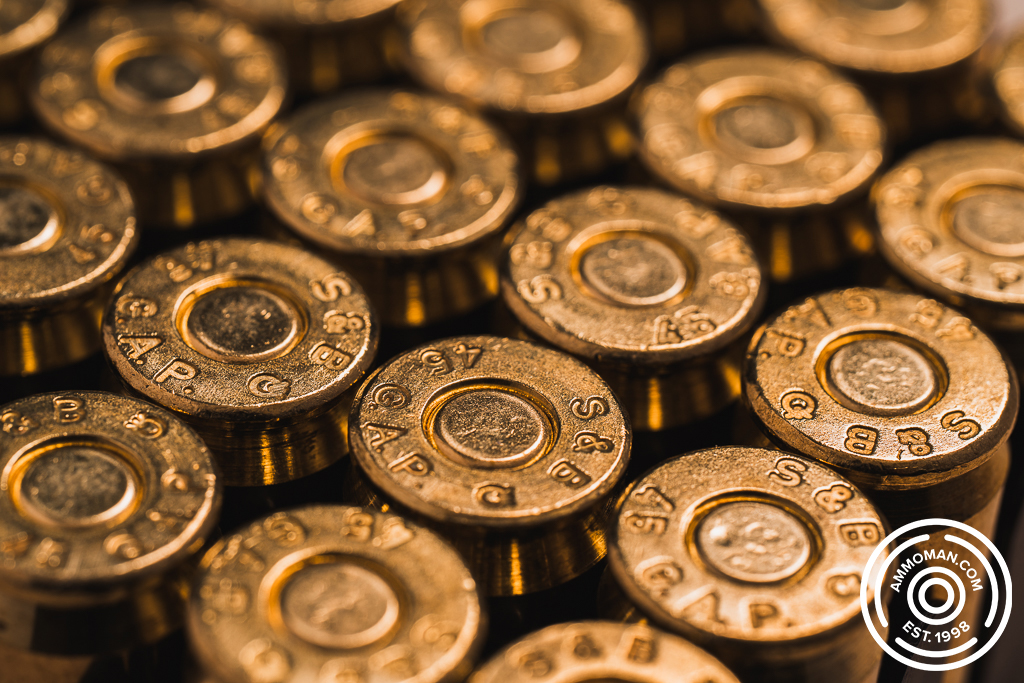
Several questions weighed on Glock’s collective minds during the turn of the 21st century. Prominent among them were:
- How can we fit ten rounds of 45 ACP ammunition into a handgun with a more compact grip?
- What would happen if we shortened the 45 ACP into an altogether novel cartridge, which we could easily do considering how much superfluous case capacity the old round has? And, while we are at it, fortify the case head so as to reduce the risk of neck blowouts?
- Wouldn’t it be nice if we could manufacture handguns chambered for a cartridge of our own design, as opposed to stamping the names of ammunition developed by other companies on their slides?
This line of thinking compelled Glock to develop the 45 Glock Auto Pistol (GAP), which they began producing in 2003. They have not introduced another new cartridge since.
An Ill-Fated Idea
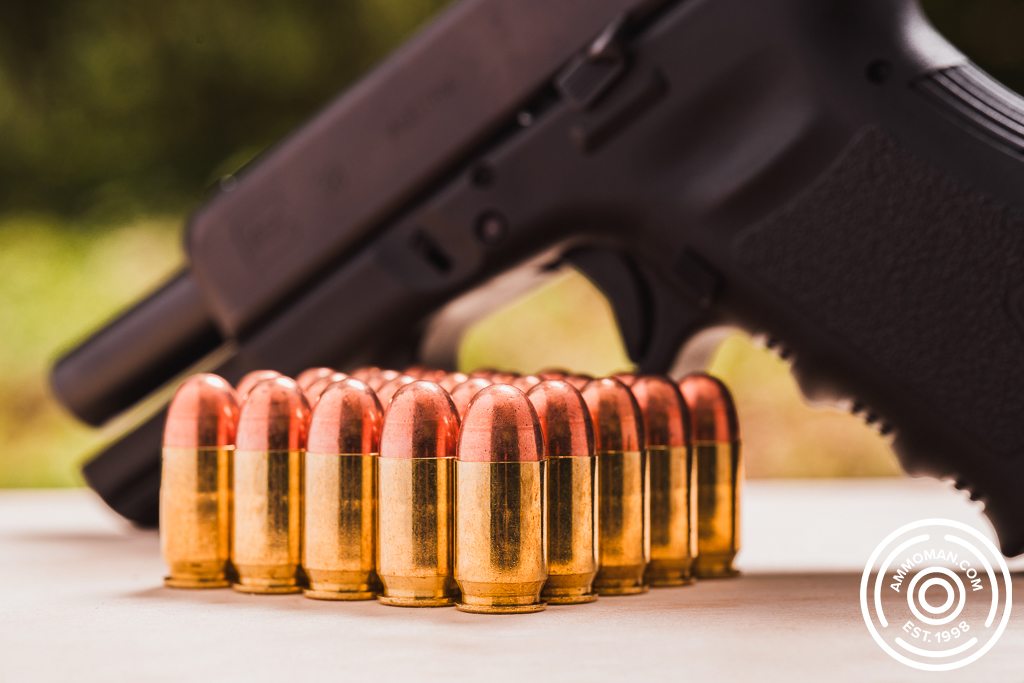
Glock’s reasoning may have paid off if not for the expiration of the Assault Weapons Ban one year after the 45 GAP’s arrival on the market. The federally imposed ten-round limit on newly manufactured handgun magazines vanished overnight, which meant the shorter and narrower 9mm (which easily exceeds ten rounds in a full-size handgun’s magazine) could rise further to prominence. Demand for magazines that pack ten rounds of .45 caliber ammunition dropped in turn.
All of this is to say that the 45 GAP never won mainstream appeal. Some law enforcement agencies, notably the Pennsylvania State Police and the Florida Highway Patrol, adopted (but have since abandoned) it. Glock continues to produce the Glock 37 pistol, although we’d hesitate to recommend it to someone who isn’t (A) a cop (or retired cop) who is already familiar with the 45 GAP, or (B) an enthusiast who wants to be able to fire an increasingly niche handgun cartridge, and doesn’t mind that its performance is virtually indistinguishable from an incomparably more popular alternative.
45 GAP vs. 45 ACP
Just how similarly does the 45 GAP ammo perform to the 45 ACP? We’re glad you asked, or else we would have created this comparison chart for no reason.
| Velocity (fps) | Energy (ft lbs) | Elevation (in) | |||||||||||||||
|---|---|---|---|---|---|---|---|---|---|---|---|---|---|---|---|---|---|
| Range (yds) | 0 | 25 | 50 | 75 | 100 | 0 | 25 | 50 | 75 | 100 | 0 | 25 | 50 | 75 | 100 | ||
| 45 GAP 185gr TMJ | 1060 | 999 | 951 | 910 | 874 | 462 | 410 | 371 | 340 | 314 | -0.2 | 1 | 0 | -3.4 | -9.4 | ||
| 45 GAP 200gr TMJ | 990 | 946 | 908 | 875 | 845 | 435 | 397 | 366 | 340 | 317 | -0.2 | 1.1 | 0 | -3.7 | -10.3 | ||
| 45 GAP 230gr FMJ | 807 | 794 | 782 | 770 | 758 | 333 | 322 | 312 | 303 | 294 | -0.2 | 1.7 | 0 | -5.2 | -14 | ||
| 45 ACP 185gr TMJ | 1050 | 991 | 944 | 904 | 869 | 453 | 404 | 366 | 336 | 310 | -0.2 | 1 | 0 | -3.4 | -9.5 | ||
| 45 ACP 205gr SHP | 970 | 941 | 916 | 892 | 870 | 428 | 403 | 382 | 362 | 345 | -0.2 | 1.1 | 0 | -3.7 | -10.2 | ||
| 45 ACP 230gr TMJ | 830 | 812 | 794 | 777 | 761 | 352 | 336 | 322 | 309 | 296 | -0.2 | 1.6 | 0 | -5 | -13.6 | ||
As you can see, the 45 GAP closely mimics the 45 ACP. It essentially mirrors the older round’s performance when the two are loaded with bullets of the same weight.
And that’s the point. The 45 GAP’s ballistics weren’t intended to outclass those of the 45 ACP. Its chief appeal is its shorter overall length, which facilitated the design of more ergonomic handguns without forfeiting stopping power. Had ten rounds remained the federally imposed limit on handgun magazine capacity, then the 45 GAP very well may have caught fire. But since that is no longer the case, the 9mm was able to ape a large portion of the market that Glock had (wrongly) presumed would continue existing.
In summary, the 45 GAP is a fine cartridge in its own right. Its virtually identical performance to that of the second most popular semi-automatic handgun cartridge in the United States makes it suitable for personal protection, and familiar to anyone who already knows their 45 ACP. It was simply designed to fill a niche that ceased to exist shortly after its introduction, and grows increasingly irrelevant with each passing year.