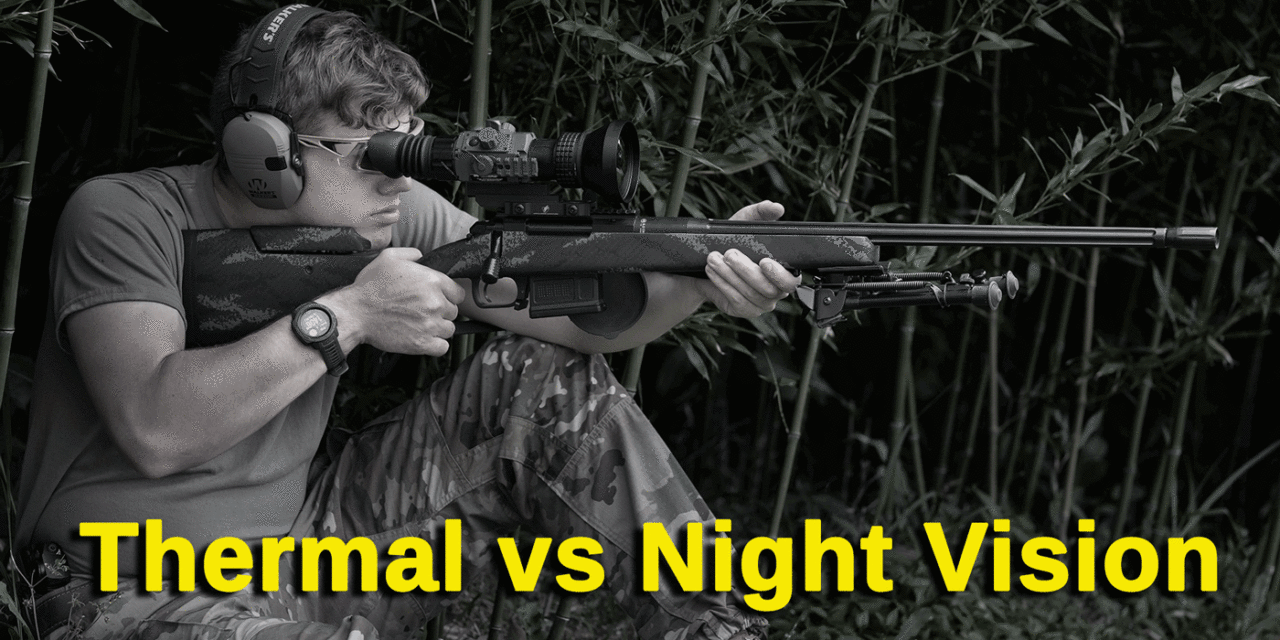
The two main types of weapon-mounted night vision are thermal and amplified (commonly called “night vision”.)
Thermal sees the long wavelengths of the far infrared spectrum, such as body and engine heat. Amplified relies on making the best use of the tiniest amounts of available visible light and near infrared, which includes very hot objects like almost-glowing sound suppressors. Near infrared also makes use of active illuminators, usually mounted on the weapon as lights or lasers. Both types have advantages and disadvantages.
What Thermal Offers Shooters
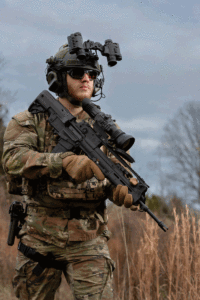
A rifleman with an Armasight 640 thermal optic
Thermal optics have first been popularized by movies like Predator, but modern devices have evolved far beyond 1990s technology. Resolution has improved considerably, and 640×480 imagers are now accessible to users with budgets far short of Special Forces.
Thermal scopes usually output rectangular images, making them easy to save as digital photos or video. While the imagers can detect minute differences in temperature, the nature of heat makes detection quite easy. A thermal scope can easily allow detecting an animal at 400 yards, resolving that animal as a cat at 200, and recognizing a specific feline at 100. Engines, aircraft silhouetted against cold sky, people and animals, all stand out dramatically despite efforts to camouflage the thermal signature with space blankets or standoff screens. The long wavelengths of heat don’t decay much with distance. That gives us as contrasty a picture afar as near, which also removes atmospheric perspective. Rangefinding with thermal optics is done either with stadia lines or with standalone laser rangefinders.
Disadvantages to Thermal
Downsides to thermal are simple: high power consumption, fairly narrow angle of view, limited resolution. They are terrific for seeing the unusual in the landscape, but less great for seeing the landscape itself: most of the terrain features have minimal thermal differences, so ground details usually resolve with very low contrast. Also, thermal lenses are usually very fast, with correspondingly shallow depth of field. That’s not a problem for a 100 yard target, but difficult for navigation when focus is needed in the 6-10ft range.
Why use Night Vision or Amplified?
How Amplified Works
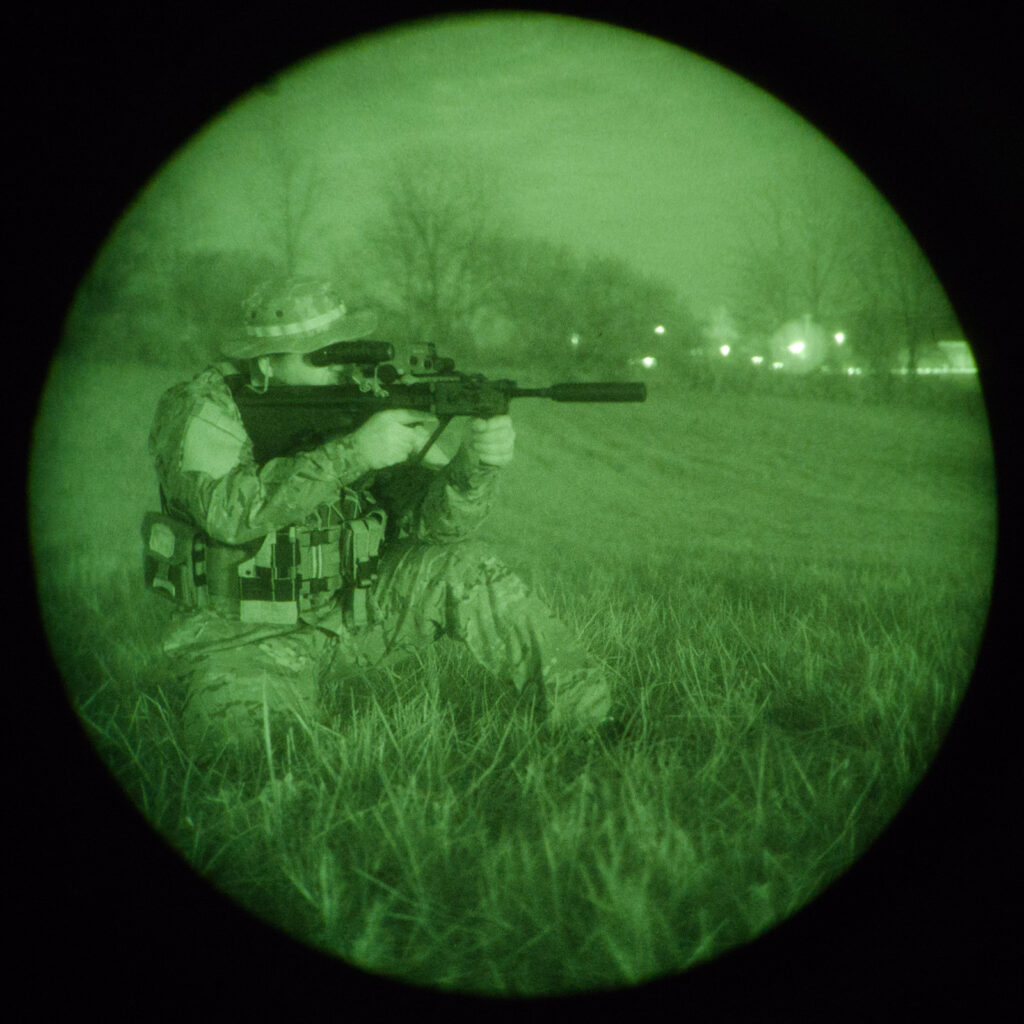
A look through a night vision optic.
Amplified night vision starts by turning photons into electrons. It separates them into pixel equivalents, boosting the signal intensity, and then exciting a phosphor screen — similar to the old CRT monitors in some regards. Night vision goggles or scopes usually provide a circular image, and the angle of view can be quite wide. That makes the lens easier to use for navigation, and the tones of the environment are more consistent with what an unaided eye would see in daylight. You can use night vision goggles or scopes for targeting with scopes or lasers, visible or infrared, but properly designed camouflage will make foes far harder to spot than with thermals. The realism of the amplified night vision is both its greatest strength and its downfall, as hot targets do not stand out for the shooter to spot. Battery consumption is a little less enthusiastic than with thermals.
You can use both types as standalone and clip-on units. Both types are sensitive enough to pick up the heat of projectiles departing downrange to produce a subtle tracer effect. Dim IR tracers do even better for NV goggles, while regular purpotechnic tracers show up more vividly on thermal scopes. Standalone sights often produce a better overall image, but they are less flexible for switching from day to night use, and harder to share between multiple guns with different zeroes. Clip-on optics limit magnification to about 2-2.5x, but allow instant switchovers from gun to gun.
Why Not Both? (If You Can Afford It)
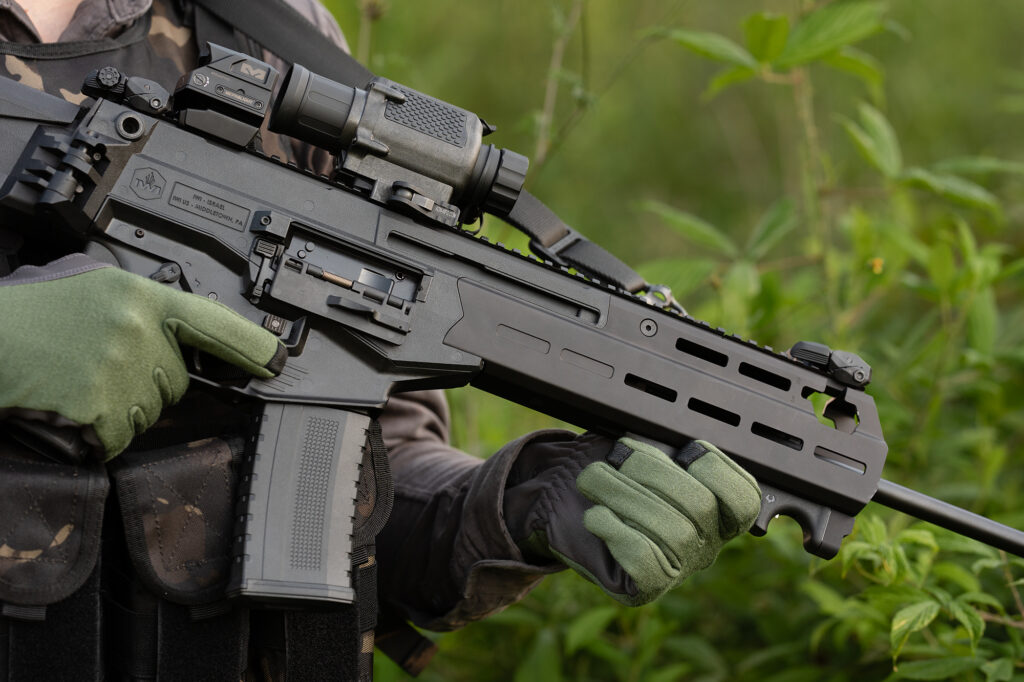
An IWI Carmel rifle with Armasight Jockey 640 clip-on thermal.
Combination units with two lenses and two sensors aim to combine the best features of both systems. They tend to be bulky. You’ll need bigger batteries in addition to two lenses, each of which has to be individually focused. Also, the lenses aren’t perfectly collimated up close, so the two images are generally slightly out of register. Due to different refresh rates, thermal and amplified pictures often shimmer as well.
The other limitation of combination units is that they are tied to firearms, being too heavy for head mounts. Viewing the environment without pointing a rifle at everything and everyone requires taking it off the gun for handheld use, then replacing it in the dark for firing. Two separate units, a wearing amplified monocular for navigation and a gun-mounted thermal scope or clip-on for targeting solves both issues without having to flag anyone with a muzzle. Expensive? Yes. Effective? Ask the US military who mainly use that combination for serious operations.