
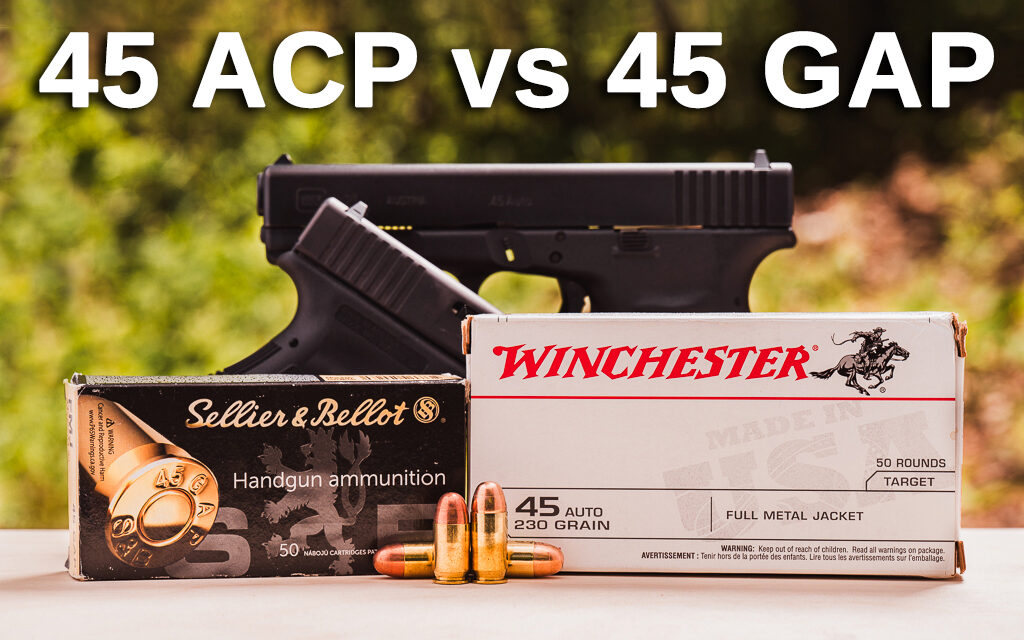
The 45 Automatic Colt Pistol (ACP, or Auto) is more than a cartridge. As the U.S. Armed Forces’ standard issue handgun ammunition from 1911 until 1985, it is emblematic of our country’s greatest era. And though it may not be as popular as 9mm, the 45 ACP’s enthusiasts are far, far more devoted than those of any other round. (Seriously. Those guys love their forty-fives.)
Glock and Speer already knew all this when they decided to improve upon the 45 ACP. “What if we strengthened the 45 ACP’s case head so as to reduce the risk of a neck blowout?” their engineers asked themselves. “And so long as we’re asking ourselves important questions, what if we shortened the 45 ACP’s case so as to permit the design of a more compact handgun?”
Those lines of questioning impelled the partnership to develop a brand new cartridge: the 45 Glock Auto Pistol (GAP; not to be confused with where you buy pants). The cartridge, which was introduced in 2003, wasn’t a total flop. A sizeable number of shooters recognized its supposed advantages and made it their own, such that 45 GAP remains in production over two decades later.
The 45 GAP absolutely, positively did not obsolete the 45 ACP. And although it still clings to some degree of relevance, it is almost certainly only a matter of time before it goes the way of the dodo bird.
But just how does the 45 GAP compare to its predecessor, really? Is favoring the niche and fated-to-someday-disappear 45 GAP worth it? That’s for you to say, but perhaps you should reserve your judgement until you have finished reading my painstakingly researched comparison article. But first, an important question:
Can You Fire 45 GAP Ammo in a 45 ACP Firearm?
We wouldn’t recommend it because we have lawyers who insist upon it. But, technically speaking, it might fire. Although there’s no real reason to and performance would suffer a great deal.
You can’t fire 45 ACP in a 45 GAP firearm, though. The older cartridge is simply too long to fit in the 45 GAP’s chamber.
45 ACP vs. 45 GAP: Physical Dimensions
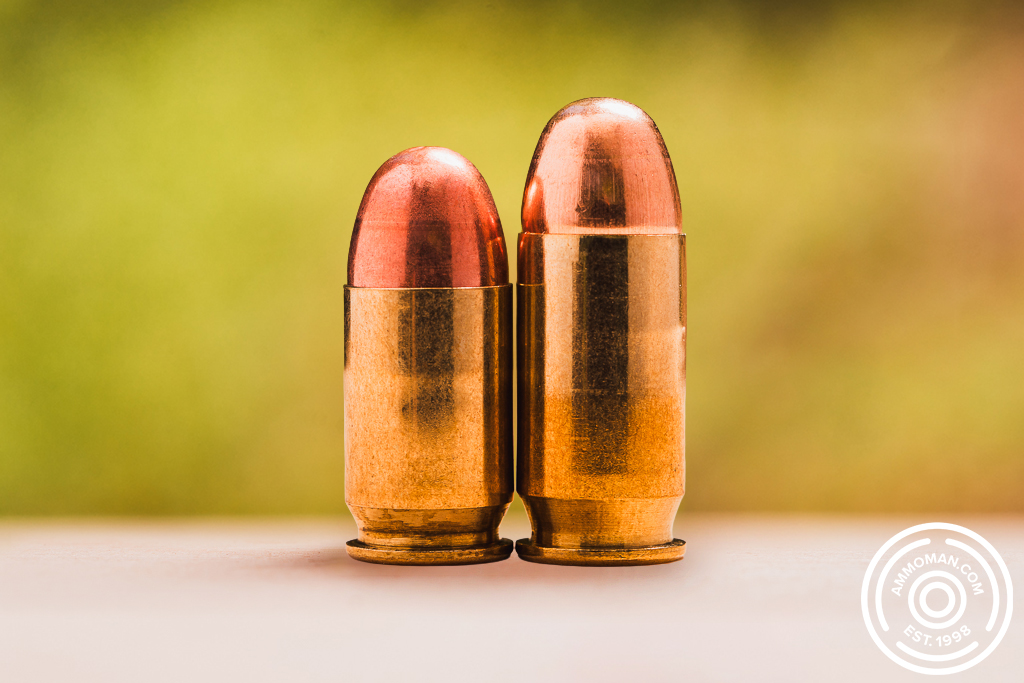
The shorter 45 GAP ammo (left) next to a 45 ACP cartridge (right)
Doesn’t matter if you’re comparing two handgun cartridges for an article or two apple pies at the county fair bake-off. You’ve got to put things side by side if you want to make sense of them.
| 45 GAP | 45 ACP | |
|---|---|---|
| Case type | Rebated, straight | Rimless, straight |
| Bullet diameter | .452 in | .452 in |
| Case length | .755 in (same as 9mm) | .898 in |
| Overall length | 1.070 in | 1.275 in |
| Max pressure (SAAMI) | 23,000 psi | 21,000 psi |
Needless to say, the two rounds’ bullets share the same diameter. It’s right there in their names. What really differentiates them are their case lengths. The 45 GAP’s is 0.143” shorter, which contributes to its 0.205” shorter overall length (OAL).
Its shorter OAL is pretty much the entire point of the 45 GAP. Glock and Speer conceived it in order to meet a very specific demand from law enforcement agencies; namely, a .45 caliber round that could fit inside the smaller-framed handgun required by women and people with small hands.
To this end, Glock and Speer were successful. The 45 GAP is even shorter than the 9mm cartridge (1.169” OAL). The 45 GAP’s more compact design is the reason why a Glock 37 has a narrower overall width and shorter trigger distance than the Glock 21 (albeit not by very much: 1.30” vs. 1.34” and 2.83” vs. 2.85”, respectively.
The passage of one century – and all the advancements in explosives technology contained therein – made the design of a “short 45 ACP” fairly straightforward. Glock and Speer ballisticians compensated for their new round’s smaller case capacity by loading it with a lighter charge of more potent propellant.
Interestingly, the 45 GAP’s maximum chamber pressure is the same as the 45 ACP +P’s: 23,000 psi, which enables the newer round’s 185 and 200 grain bullets to match the muzzle velocities and ballistic performance of analogous 45 ACP loads.
45 ACP vs. 45 GAP: Ballistic Performance
It’s a bit tricky to devise an expansive apples-to-apples comparison here. Speer records the two rounds’ muzzle velocities using different test barrel lengths. We should expect the 45 ACP’s 5” test barrel to accelerate its 185 grain bullet an instant longer than a 4” one, which would translate to relatively higher muzzle velocity. I tried comparing two middleweight loads’ performance as best as I could, but the rounds aren’t truly analogous to each other. I’m grateful to Magtech for providing data for two 230 grain FMJ loads with identical test barrel lengths.
| 45 GAP Speer 185gr TMJ; 4" bbl; 0.097 G1 BC | 45 ACP Speer 185gr TMJ; 5" bbl; 0.097 G1 BC | ||||||
|---|---|---|---|---|---|---|---|
| Range (yds) | Velocity (fps) | Energy (ft lbs) | Elevation (in) | Range (yds) | Velocity (fps) | Energy (ft lbs) | Elevation (in) |
| 0 | 1060 | 462 | -0.19 | 0 | 1050 | 453 | -0.19 |
| 25 | 999 | 410 | 1.01 | 25 | 991 | 404 | 1.02 |
| 50 | 951 | 372 | 0.01 | 50 | 945 | 367 | 0.02 |
| 75 | 910 | 340 | -3.38 | 75 | 905 | 336 | -3.43 |
| 100 | 874 | 314 | -9.4 | 100 | 869 | 311 | -9.53 |
| 125 | 842 | 291 | -18.26 | 125 | 838 | 288 | -18.5 |
| 45 GAP Speer 200gr TMJ; 4" bbl; 0.104 G1 BC | 45 ACP Federal 205gr SHP; 5" bbl; 0.153 G1 BC | ||||||
| Range (yds) | Velocity (fps) | Energy (ft lbs) | Elevation (in) | Range (yds) | Velocity (fps) | Energy (ft lbs) | Elevation (in) |
| 0 | 990 | 435 | -0.19 | 0 | 970 | 428 | -0.19 |
| 25 | 946 | 397 | 1.13 | 25 | 941 | 404 | 1.15 |
| 50 | 908 | 367 | 0.02 | 50 | 916 | 382 | 0.02 |
| 75 | 875 | 340 | -3.74 | 75 | 892 | 362 | -3.71 |
| 100 | 845 | 317 | -10.33 | 100 | 870 | 345 | -10.16 |
| 125 | 817 | 296 | -19.96 | 125 | 850 | 329 | -19.48 |
These charts were cooked up using ballistic data provided by various ammunition manufacturers. They’re approximations, and cannot predict the ballistic performance you would witness with any real certainty.
That said, these charts illustrate just what we expected to see: functionally identical ballistic performance by the 45 ACP and the round that was specifically designed to emulate it as closely as possible. If you are only concerned about choosing the flatter-shooting cartridge (which would theoretically be easier to aim), then you would have no reason to favor either of these rounds over the other.
45 ACP vs. 45 GAP: Stopping Power
“Stopping power” is a nebulous concept. There’s no real definition to it, though we can reasonably assume it encompasses penetration depth, wound channel diameter, and striking energy.
Once again, the similarities to these two rounds are obvious. So long as they share the same weight, either round’s bullet has the same sectional density (a mathematical representation of how efficiently a bullet pierces flesh). Likewise, the rounds’ shared caliber means they gouge wound channels of the same diameter. And as you can see in our charts, the two rounds hit with roughly the same amount of force at any given distance.
We did the math to see how far the aforementioned rounds would conserve at least 260 ft lbs of kinetic energy (which is reasonable acceptable minimum for defense). One glance at our chart will show you that these rounds share the same “effective range” (noting that the 45 GAP 200 grain TMJ and 45 ACP 205 grain SHP loads really aren’t all that analogous to one another).
| 260 ft lbs | |
|---|---|
| 45 GAP Speer 185gr TMJ | 165 |
| 45 GAP Speer 200gr TMJ | 177 |
| 45 GAP Magtech 230gr FMJ | 246 |
| 45 ACP Speer 185gr TMJ | 161 |
| 45 ACP Federal 205gr SHP | 259 |
| 45 ACP Magtech 230gr FMJ | 246 |
One other factor contributes to stopping power: shot placement. You could have the world’s most powerful handgun, but it’ll be about as useful as teats on a boar if you can’t aim it. That’s only to say that “stopping power” assumes competent marksmanship, and testifies to the importance of target practice.
45 ACP vs. 45 GAP: Recoil
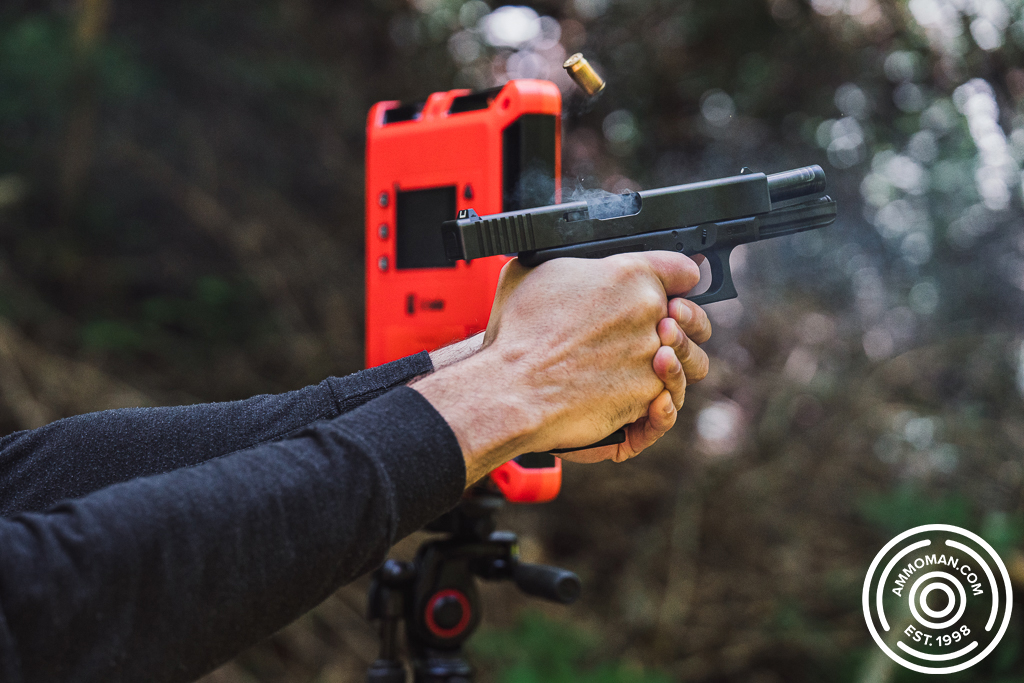
Powerful recoil can be fun, but you would ideally experience as little of it as possible while you’re firing in defense of your life. The stronger the recoil, the sharper the muzzle jerks upward on ignition – and the sharper the “muzzle flip,” the longer it will take to restore your aim on target after firing each shot.
Does one of these rounds kick harder than the other? Let’s dig deeper by estimating our six examples’ free recoil energy, which can be calculated from four figures: firearm weight, propellant weight, bullet weight, and muzzle velocity. A loaded Glock 21 weighs 2.43 pounds. A loaded Glock 37 weighs 2.20 pounds. We’ll presume we’re firing two hypothetical 2.3-pound pistols for the sake of a closer comparison. We’ll also assume each round’s propellant charge weight, noting that the real figures are probably different.
| Propellant Weight (gr) | Recoil Energy (ft lbs) | |
|---|---|---|
| 45 GAP Speer 185gr TMJ | 5 | 6.74 |
| 45 GAP Speer 200gr TMJ | 7 | 7.49 |
| 45 GAP Magtech 230gr FMJ | 8 | 7.45 |
| 45 ACP Speer 185gr TMJ | 6 | 6.93 |
| 45 ACP Federal 205gr SHP | 9 | 8.20 |
| 45 ACP Magtech 230gr FMJ | 10 | 8.11 |
Take our recoil comparison with a grain of salt. These rounds can theoretically contain identical charges of propellant, and firearm weight significantly affects free and felt recoil. Ultimately, it’s safe to conclude that the 45 GAP and 45 ACP are so similar in recoil that there is no reason to favor one over the other. With that said, the 45 GAP is more likely (but not certain) to have lower recoil – the result of its lighter charge of propellant.
45 ACP vs. 45 GAP: Availability and Cost
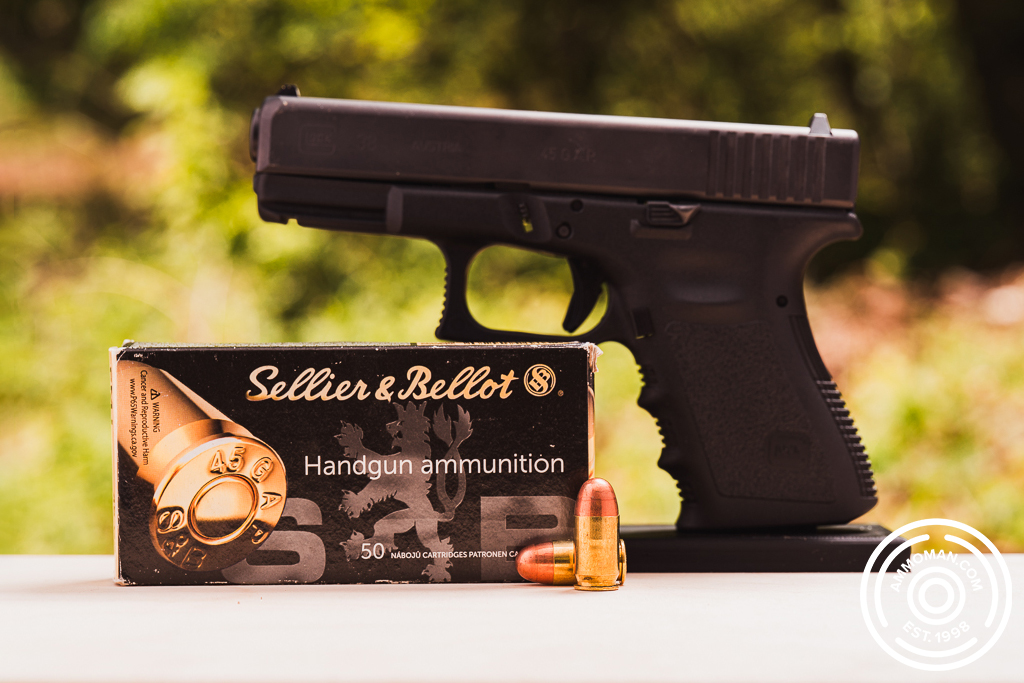
At the beginning of this article, we alluded to the 45 ACP being a sort of cultural institution. It still is now that you’re nearing the end of the article. PEOPLE LOVE 45 ACP. That’s why there will always be an enormous selection of 45 ACP ammo available for every application: target, defense, competition, and even bear defense (which the 45 ACP isn’t ideal for, but hey – the bears don’t know that).
The 45 GAP is not popular. We wouldn’t go so far as to call it a “commercial failure,” as it has managed to remain in some sort of production for over two decades, but it’s absolutely niche. Manufacturers produce an incomparably larger amount of 45 ACP every year. There are dozens more varieties of 45 ACP available for sale. And because manufacturers can crank out so much more of it, 45 ACP costs about one-third less than 45 GAP ammo (which you’ll be lucky to find in stock at a brick-and-mortar store).
Conclusion
Its stronger case neck aside, the 45 GAP’s only significant advantage over 45 ACP is its shorter length, which permits the design of a handgun with a narrower grip (i.e. the kind of handgun women and smaller-framed people have an easier time handling). The 45 GAP’s ballistic performance, stopping power and recoil are otherwise indistinguishable from those of the cartridge it was designed to mimic as closely as possible.
The 45 GAP might have become a viable option for everyday carry were it not for one thing. It never took off. We sincerely doubt whether factories will continue loading Glock’s foray into ammunition design a few decades from now. At that point, only handloaders will be able to produce it.
If you’re determined to use a .45 cal handgun round for defense – or any other reason – choose 45 ACP. If you find pistols chambered for it to be too large, don’t consider the 45 GAP. Instead gravitate toward 40 S&W, 380 Auto, 9mm, 32 ACP, or any of the other shorter and narrower handgun cartridges. Heck, if you need a really small grip, then you might as well go with a revolver.
At the end of the day, the takeaway is simple: Continue depending on the 45 GAP if you’re already accustomed to it, but don’t pick up the round for the first time now. It’s just not different or advantageous enough to justify its thin selection of pistols and ammo.