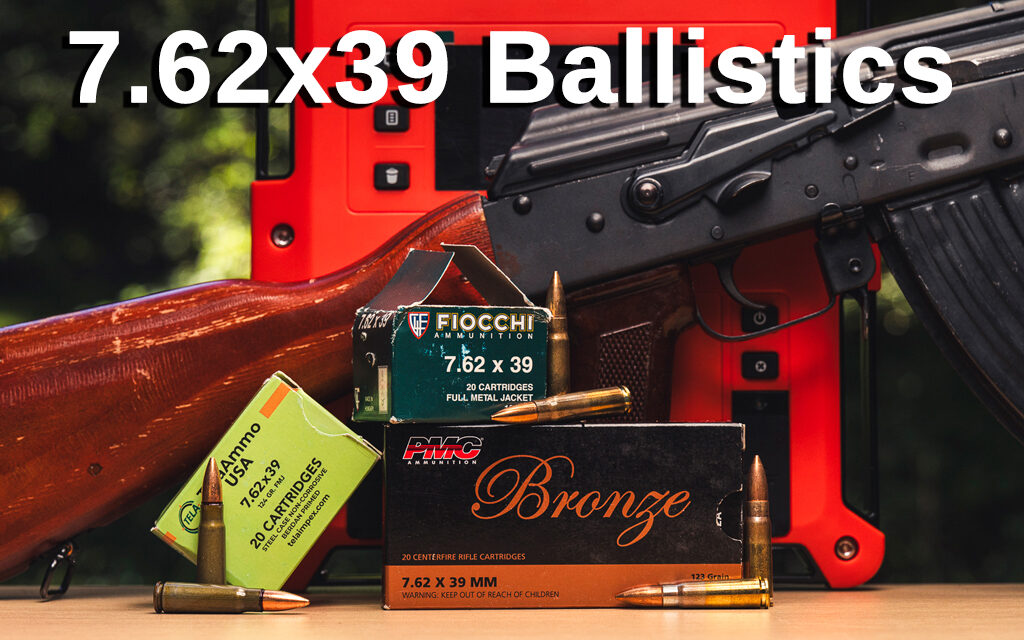
If you’re considering adding a new brand of 7.62×39 ammunition to your arsenal, then you have come to the right place: AmmoMan.com, where you can (A) scroll down to observe the internet’s largest collection of 7.62×39 ballistics tables, and (B) continue scrolling even further to read some interesting things about the round Kalashnikov made famous.
7.62×39 Ballistic Charts
The AmmoMan.com team has collected ballistic data from a multitude of popular ammunition manufacturers and assembled them into one handy point of reference. Please consult the notes below for more information on ballistic data and how we calculated ours.
Federal
| Mfr / Brand | SKU | Bullet | G1 BC / Bbl (in) |
|---|---|---|---|
| Federal Power-Shok | 76239B | 123gr JSP | 0.274 / 24" |
| Range (yds) | Velocity (fps) | Energy (ft lbs) | Elevation (in) |
| 0 | 2350 | 1509 | -1.5 |
| 100 | 2054 | 1153 | 3.4 |
| 200 | 1783 | 868 | 0 |
| 300 | 1539 | 647 | -14.4 |
| 400 | 1328 | 482 | -43.6 |
| 500 | 1163 | 369 | -92.7 |
| Federal American Eagle | A76239A | 124gr FMJ | 0.298 / 24" |
| Range (yds) | Velocity (fps) | Energy (ft lbs) | Elevation (in) |
| 0 | 2350 | 1521 | -1.5 |
| 100 | 2077 | 1188 | 3.3 |
| 200 | 1825 | 917 | 0 |
| 300 | 1595 | 700 | -13.8 |
| 400 | 1392 | 533 | -41.4 |
| 500 | 1223 | 412 | -87 |
Fiocchi
| Mfr / Brand | SKU | Bullet | G1 BC / Bbl (in) |
|---|---|---|---|
| Fiocchi Range Dynamics | 762X39A | 123gr FMJ | 0.266 / 24" |
| Range (yds) | Velocity (fps) | Energy (ft lbs) | Elevation (in) |
| 0 | 2375 | 1541 | -1.5 |
| 100 | 2069 | 1169 | 3.4 |
| 200 | 1788 | 873 | 0 |
| 300 | 1536 | 645 | -14.3 |
| 400 | 1321 | 477 | -43.5 |
| 500 | 1153 | 363 | -92.6 |
Fort Scott Munitions
| Mfr / Brand | SKU | Bullet | G1 BC / Bbl (in) |
|---|---|---|---|
| Fort Scott Munitions | 7.62x39-117-SCV | 117gr TUI | 0.247/ 20 |
| Range (yds) | Velocity (fps) | Energy (ft lbs) | Elevation (in) |
| 0 | 2336 | 1418 | -1.5 |
| 100 | 2011 | 1050 | 3.6 |
| 200 | 1715 | 764 | 0 |
| 300 | 1455 | 550 | -15.5 |
| 400 | 1242 | 401 | -47.6 |
| 500 | 1090 | 309 | -102.3 |
Hornady
| Mfr / Brand | SKU | Bullet | G1 BC / Bbl (in) |
|---|---|---|---|
| Hornady BLACK | 80788 | 111gr MonoFlex | 0.175 / 24 |
| Range (yds) | Velocity (fps) | Energy (ft lbs) | Elevation (in) |
| 0 | 2350 | 1361 | -1.5 |
| 100 | 1897 | 887 | 4.2 |
| 200 | 1508 | 561 | 0 |
| 300 | 1207 | 359 | -19.7 |
| 400 | 1025 | 259 | -63.3 |
| 500 | 920 | 209 | -139.9 |
| Hornady Frontier | FR420 | 123gr FMJ | 0.266 / 24 |
| Range (yds) | Velocity (fps) | Energy (ft lbs) | Elevation (in) |
| 0 | 2340 | 1496 | -1.5 |
| 100 | 2037 | 1133 | 3.5 |
| 200 | 1759 | 845 | 0 |
| 300 | 1511 | 623 | -14.8 |
| 400 | 1300 | 461 | -44.9 |
| 500 | 1138 | 354 | -95.8 |
| Hornady American Gunner | 80786 | 123gr HP Match | 0.276 / 20 |
| Range (yds) | Velocity (fps) | Energy (ft lbs) | Elevation (in) |
| 0 | 2350 | 1509 | -1.5 |
| 100 | 2057 | 1155 | 3.4 |
| 200 | 1786 | 872 | 0 |
| 300 | 1543 | 651 | -14.4 |
| 400 | 1334 | 486 | -43.4 |
| 500 | 1168 | 373 | -92.2 |
| Hornady BLACK | 80784 | 123gr SST | 0.295 / 20 |
| Range (yds) | Velocity (fps) | Energy (ft lbs) | Elevation (in) |
| 0 | 2350 | 1509 | -1.5 |
| 100 | 2075 | 1176 | 3.3 |
| 200 | 1820 | 905 | 0 |
| 300 | 1588 | 689 | -13.9 |
| 400 | 1384 | 523 | -41.6 |
| 500 | 1216 | 404 | -87.6 |
| Hornady Subsonic | 80787 | 255gr Sub-X | 0.365 / 20 |
| Range (yds) | Velocity (fps) | Energy (ft lbs) | Elevation (in) |
| 0 | 1050 | 624 | -1.5 |
| 100 | 988 | 553 | 17.1 |
| 200 | 939 | 500 | 0 |
| 300 | 898 | 456 | -56.4 |
| 400 | 861 | 420 | -156 |
| 500 | 828 | 389 | -302.4 |
HSM
| Mfr / Brand | SKU | Bullet | G1 BC / Bbl (in) |
|---|---|---|---|
| HSM Game King | HSM-762X39-8-N | 125gr Pro-Hunter | 0.274 / ? |
| Range (yds) | Velocity (fps) | Energy (ft lbs) | Elevation (in) |
| 0 | 2359 | 1545 | -1.5 |
| 100 | 2063 | 1181 | 3.4 |
| 200 | 1790 | 890 | 0 |
| 300 | 1545 | 663 | -14.3 |
| 400 | 1334 | 494 | -43.2 |
| 500 | 1167 | 378 | -91.8 |
Nosler
| Mfr / Brand | SKU | Bullet | G1 BC / Bbl (in) |
|---|---|---|---|
| Nosler Varmageddon | 60176 | 123gr FB Tipped | 0.309 / 24 |
| Range (yds) | Velocity (fps) | Energy (ft lbs) | Elevation (in) |
| 0 | 2350 | 1509 | -1.5 |
| 100 | 2087 | 1190 | 3.3 |
| 200 | 1842 | 927 | 0 |
| 300 | 1618 | 715 | -13.6 |
| 400 | 1419 | 550 | -40.5 |
| 500 | 1250 | 427 | -84.8 |
| Nosler | 40040 | 123gr E-Tip | 0.329 / 24 |
| Range (yds) | Velocity (fps) | Energy (ft lbs) | Elevation (in) |
| 0 | 2350 | 1509 | -1.5 |
| 100 | 2102 | 1207 | 3.2 |
| 200 | 1871 | 956 | 0 |
| 300 | 1657 | 750 | -13.2 |
| 400 | 1465 | 586 | -39.1 |
| 500 | 1298 | 460 | -81.3 |
| Nosler | 40069 | 123gr Ballistic Tip | 0.315 / 24 |
| Range (yds) | Velocity (fps) | Energy (ft lbs) | Elevation (in) |
| 0 | 2350 | 1509 | -1.5 |
| 100 | 2092 | 1195 | 3.3 |
| 200 | 1851 | 936 | 0 |
| 300 | 1630 | 726 | -13.4 |
| 400 | 1433 | 561 | -40 |
| 500 | 1265 | 437 | -83.7 |
PMC
| Mfr / Brand | SKU | Bullet | G1 BC / Bbl (in) |
|---|---|---|---|
| PMC Bronze | 7.62A | 123gr FMJ | 0.266 / 20 |
| Range (yds) | Velocity (fps) | Energy (ft lbs) | Elevation (in) |
| 0 | 2350 | 1509 | -1.5 |
| 100 | 2046 | 1143 | 3.5 |
| 200 | 1767 | 853 | 0 |
| 300 | 1518 | 629 | -14.6 |
| 400 | 1306 | 466 | -44.5 |
| 500 | 1143 | 357 | -94.8 |
Prvi Partizan
| Mfr / Brand | SKU | Bullet | G1 BC / Bbl (in) |
|---|---|---|---|
| Prvi Partizan | A-030 | 123gr SP RN | 0.204 / 24 |
| Range (yds) | Velocity (fps) | Energy (ft lbs) | Elevation (in) |
| 0 | 2461 | 1654 | -1.5 |
| 100 | 2059 | 1158 | 3.4 |
| 200 | 1699 | 789 | 0 |
| 300 | 1393 | 530 | -15.6 |
| 400 | 1161 | 368 | -49.3 |
| 500 | 1018 | 283 | -108.9 |
| Prvi Partizan | A-041 | 123gr FMJ | 0.294 / 24 |
| Range (yds) | Velocity (fps) | Energy (ft lbs) | Elevation (in) |
| 0 | 2461 | 1654 | -1.5 |
| 100 | 2178 | 1295 | 3 |
| 200 | 1914 | 1001 | 0 |
| 300 | 1672 | 764 | -12.5 |
| 400 | 1456 | 579 | -37.5 |
| 500 | 1273 | 443 | -79 |
| Prvi Partizan | A-210 | 123gr PSP | 0.279 / 24 |
| Range (yds) | Velocity (fps) | Energy (ft lbs) | Elevation (in) |
| 0 | 2461 | 1654 | -1.5 |
| 100 | 2163 | 1278 | 3 |
| 200 | 1887 | 972 | 0 |
| 300 | 1635 | 731 | -12.8 |
| 400 | 1414 | 546 | -38.8 |
| 500 | 1231 | 414 | -82.2 |
Remington
| Mfr / Brand | SKU | Bullet | G1 BC / Bbl (in) |
|---|---|---|---|
| Remington Core-Lokt | 29125 / 29127 | 125gr PSP | 0.267 / 20" |
| Range (yds) | Velocity (fps) | Energy (ft lbs) | Elevation (in) |
| 0 | 2365 | 1553 | -1.5 |
| 100 | 2061 | 1179 | 3.4 |
| 200 | 1782 | 881 | 0 |
| 300 | 1532 | 651 | -14.4 |
| 400 | 1318 | 482 | -43.7 |
| 500 | 1152 | 368 | -93.2 |
Sellier & Bellot
| Mfr / Brand | SKU | Bullet | G1 BC / Bbl (in) |
|---|---|---|---|
| Sellier & Bellot | SB76239A | 124gr FMJ | 0.286 / 20.5 |
| Range (yds) | Velocity (fps) | Energy (ft lbs) | Elevation (in) |
| 0 | 2421 | 1614 | -1.5 |
| 100 | 2133 | 1252 | 3.1 |
| 200 | 1865 | 958 | 0 |
| 300 | 1622 | 724 | -13.1 |
| 400 | 1407 | 545 | -39.6 |
| 500 | 1229 | 416 | -83.7 |
| Sellier & Bellot | SB76239B | 124gr SP | 0.238 / 20.5 |
| Range (yds) | Velocity (fps) | Energy (ft lbs) | Elevation (in) |
| 0 | 2438 | 1637 | -1.5 |
| 100 | 2092 | 1206 | 3.3 |
| 200 | 1778 | 871 | 0 |
| 300 | 1500 | 620 | -14.3 |
| 400 | 1270 | 444 | -44.3 |
| 500 | 1103 | 335 | -95.9 |
Underwood
| Mfr / Brand | SKU | Bullet | G1 BC / Bbl (in) |
|---|---|---|---|
| Underwood | 568 | 123gr Controlled Chaos | 0.290 / ? |
| Range (yds) | Velocity (fps) | Energy (ft lbs) | Elevation (in) |
| 0 | 2450 | 1640 | -1.5 |
| 100 | 2163 | 1279 | 3 |
| 200 | 1897 | 983 | 0 |
| 300 | 1654 | 747 | -12.7 |
| 400 | 1438 | 565 | -38.2 |
| 500 | 1256 | 431 | -80.7 |
Winchester
| Mfr / Brand | SKU | Bullet | G1 BC / Bbl (in) |
|---|---|---|---|
| Winchester Power-Point | X76239 | 123gr SP | 0.244 / ? |
| Range (yds) | Velocity (fps) | Energy (ft lbs) | Elevation (in) |
| 0 | 2365 | 1528 | -1.5 |
| 100 | 2033 | 1130 | 3.5 |
| 200 | 1732 | 820 | 0 |
| 300 | 1467 | 588 | -15.2 |
| 400 | 1249 | 426 | -46.7 |
| 500 | 1093 | 326 | -100.5 |
| Winchester USA | Q3174 / W7623920 | 123gr FMJ | 0.245 / ? |
| Range (yds) | Velocity (fps) | Energy (ft lbs) | Elevation (in) |
| 0 | 2355 | 1515 | -1.5 |
| 100 | 2026 | 1121 | 3.5 |
| 200 | 1726 | 814 | 0 |
| 300 | 1463 | 585 | -15.3 |
| 400 | 1246 | 424 | -47 |
| 500 | 1092 | 325 | -101.2 |
| Winchester Deer Season XP | X76239DS | 123gr Extreme Point | 0.304 / ? |
| Range (yds) | Velocity (fps) | Energy (ft lbs) | Elevation (in) |
| 0 | 2380 | 1547 | -1.5 |
| 100 | 2111 | 1217 | 3.2 |
| 200 | 1860 | 945 | 0 |
| 300 | 1631 | 727 | -13.3 |
| 400 | 1427 | 556 | -39.7 |
| 500 | 1254 | 430 | -83.3 |
Notes on Ballistic Coefficient
- Ballistic coefficient (BC) is a numerical representation of how efficiently a bullet moves through the air. It reflects the bullet’s capacity to conserve velocity, energy, and momentum, as well as its ability to resist the influence of cross and vertical winds. When all other variables are equal (e.g. weight, muzzle velocity, etc.), a bullet with a higher BC will exhibit a flatter trajectory compared to a bullet with a lower one.
- A bullet’s shape determines which type of BC mathematical model most accurately reflects its ballistic performance. The G1 BC is the old industry standard, and best predicts flat base projectiles’ ballistic performance. G7 BC is better suited for sleeker boat tail projectiles, which are commonly favored for long-distance shooting. Regardless, we used G1 BC, as multiple ammo and bullet manufacturers do not provide G7 BC data regardless of bullet design.
- Some manufacturers do not provide BC data, but do report their ammunition’s bullet velocities at 0 (i.e. muzzle) and 500 yards. In these cases, we calculated BC assuming the following atmospheric conditions: temperature, 59.0 °F; pressure, 29.92 in Hg; humidity, 50.0%; altitude, 0.0 feet.
- We calculated the ballistic data on this webpage using a ballistic calculator. We calculated these data assuming the following atmospheric conditions: temperature, 59.0 °F; pressure, 29.92 in Hg; relative humidity, 50.0%; altitude, 0.0 feet.
Notes on Performance Variation
- Real world performance invariably varies. Different lots of the same ammunition can perform differently from one another. Slight manufacturing variations affecting chamber pressure, muzzle velocity, and bullet weight can and will make two rounds from the same box of ammunition perform differently. Different firearms produce different results, especially if they have different barrel lengths (longer barrels tend to produce higher muzzle velocities, as they afford more time for the propellant to transfer its energy to the projectile). Atmospheric conditions bear significantly on ammunition performance. The shooter, of course, ultimately has the greatest influence over ammunition performance.
- Many manufacturers do not report the lengths of the test barrels they use to record muzzle velocities. We omitted this data wherever it was unavailable at the time of writing.
Background of the AK-47
If you could choose to be be anyplace, anytime, it would not be Bryansk Oblast, Russia on September 30th, 1941. That would put you on the receiving end of a Nazi blitzkrieg, courtesy of none other than the architect of blitzkrieg warfare himself: Generaloberst Heinz Guderian, who was 57 varieties of nasty.
Mikhail Kalashnikov wasn’t so lucky. He was right there, right then.
The Red Army tank commander’s T-34 was walloped by German artillery during the Battle of Bryansk, which the Nazis won, and which resulted in 100,000 Russians killed or missing in action; 600,000 more captured.
Kalashnikov was fortunate enough not to fall into either of those categories. While convalescing in a Soviet military hospital, he overheard his comrades lamenting how their slow-firing, jam-happy Mosin-Nagant rifles had failed them.
Kalashnikov – a preternaturally talented tinkerer, and autodidact – thought to himself “Aha!” (or whatever the Russian equivalent of “Aha!” is). “I will build a new rifle for the Red Army. It will be nothing like my rejected PPK-42 7.62×25 submachine gun prototype. It will be bigger. It will be more powerful. It will dependably serve my countrymen. And to do it, I will draw inspiration from one of the greatest American inventions of all time: the M1 Garand.”
A Brief Background of the 7.62×39
The Red Army passed over Kalashnikov’s next prototype in favor of Sergei Gavrilovich Simonov’s SKS. But his next design, which he submitted in an assault rifle competition in 1946, was a winner.
All three of those rifles were engineered around the 7.62×39 cartridge, though neither man had any hand in designing it. It was a group effort by the People’s Commissariat for Armaments, which began developing the new intermediate combat cartridge in 1943.
Like Kalashnikov and his wounded comrades, the Soviets perceived the need for a new “Goldilocks” combat round. It would be stronger than pistol ammunition, yet lighter and softer-recoiling than the Mosin-Nagant’s full-power 7.62x54r. It would also allow troops to reliably direct effective fire out to 300 to 400 yards – or rapidly dump magazines into close-range enemies – without incurring excessive fatigue in the process.
This cartridge would become the Soviet Union’s primary standard-issue rifle ammunition from 1945 until its replacement by the 5.45×39 in 1974. It would also become *the* most ubiquitous centerfire rifle cartridge, as around 100 million AK-47s and their variants have been manufactured worldwide to date.
How to Buy the Right 7.62×39 Ammo
There are a few different “flavors” of 7.62×39 ammunition. Selecting the right one is crucial if you hope to enjoy your SKS, AK-47, or whatever to the best of its abilities.
WWII and Cold War Military Surplus 7.62×39
The Soviet Union and allied nations produced fathomless quantities of ammunition during WWII and the Cold War that followed. Tens of billions of rounds became military surplus, much of which is still sold to good Americans (e.g. you).
This ammunition typically ships in “spam cans”: sealed steel containers which keep their contents dry and safe in storage and on the battlefield. Such spam cans may be further packaged in wood crates bearing Cyrillic stenciling. Military surplus 7.62×39 never packaged in colorful boxes like you’d see on retail shelves.
Military surplus 7.62×39 comes with two major caveats:
- Its primers are normally “corrosive.” They’re inoffensive until you fire them, at which point they produce hygroscopic salts: chemical compounds that absorb atmospheric moisture. Failure to clean your rifle in a special fashion afterward will result in catastrophic rusting.
- Its projectiles normally have “bimetal jackets.” These are predominantly made of steel. Many commercial gun ranges prohibit bullets capable of attracting a magnet because the steel they contain poses a higher risk of (A) emitting sparks, (B) damage to range equipment, and (C) injurious bullet splash.
So long as you clean your rifle correctly immediately after target fun has ended (e.g. using boiling-hot soapy water) and don’t intend to visit a gun range that prohibits “magnetic ammo,” military surplus 7.62×39 is a great way to have fun and save money.
Steel-Cased Commercial 7.62×39
Military surplus has yet another shortcoming, depending on which way you look at it: steel cases. These are far more economical than conventional brass alternatives. They also allow more fouling to enter the action, and are not suitable for handloading for two main reasons:
- Steel is much more rigid than brass, and therefore fails to return to its original dimensions following ignition. It is also devilishly hard to reshape.
- Steel cases are normally loaded with Berdan primers. These are more economical than the conventional Boxer alternative. But their sizes aren’t well standardized, and they have external anvils that wear down when they are struck by the firing pin. They also have two flash holes instead of a single central one, which makes Berdan primers an absolute pain in the hinder to line up.
Modern ammo manufacturers frequently leverage the cost-saving power of steel cases – especially Russian (e.g. Wolf), Eastern European, and Turkish ones. Such steel-cased ammo is more affordable because it includes nearly zero copper. That extends to its bullets, which are typically bimetal jacketed and therefore forbidden at ranges that ban magnetic ammo.
Brass-Cased Commercial 7.62×39
Reloadable brass cases. Noncorrosive Boxer primers. Nonmagnetic projectiles. This is the crème de la crème 7.62×39 ammunition, which is typically manufactured by industry giants such as:
Choose modern, recently manufactured brass-cased 7.62×39 ammo for home defense and hunting. It’s the most reliable option at your disposal, and it is available loaded with soft point (SP) and polymer tip (PT) projectiles that reliably expand to inflict accentuated damage to the target.
Intermediate Combat vs. Full-Power Rifle Cartridges
The 7.62×39 is an intermediate combat cartridge: weaker than a full-power alternative by design. Though its effective range is nearer, it is vastly favorable during many modern warfare scenarios owing to its lighter weight and lower recoil.
That raises the question: Just how much weaker is an intermediate cartridge? The following table is by no means comprehensive, but it does illustrate the power gap by placing three intermediate and three full-power examples side by side. There’s no need to tell you which is which.
Bbl (in) Velocity (fps) Energy (ft lbs) Elevation (in)
Ctg Range (yds) 0 100 200 300 400 0 100 200 300 400 0 100 200 300 400
300 BLK 125gr FMJ 16 2175 1867 1590 1353 1167 1313 967 702 508 378 -1.5 4.3 0 -18.1 -55.4
5.56x45 62gr FMJ M855 20 3100 2784 2490 2214 1956 1323 1067 854 675 527 -1.5 1.5 0 -7.1 -21.4
7.62x39 123gr FMJ 20 2350 2046 1767 1518 1306 1509 1143 853 629 466 -1.5 3.5 0 -14.6 -44.5
30-06 150gr FMJ 24 2740 2522 2314 2116 1929 2501 2119 1784 1492 1239 -1.5 2 0 -8.5 -24.8
7.62x51 147gr FMJBT 24 2800 2573 2356 2151 1955 2559 2160 1813 1510 1248 -1.5 1.9 0 -8.2 -23.9
308 Win 147gr FMJ 24 2780 2553 2338 2133 1939 2523 2129 1785 1486 1228 -1.5 1.9 0 -8.3 -24.2
All of this is to underscore the most important thing to bear in mind about the 7.62×39: its limitations. It is a bona fide beast at close range, and sufficient for taking whitetail at 150 yards, 200 yards tops. But if you’re looking for a round that ethically anchors bucks at 500 yards, or gives an average Joe any realistic chance of reaching the coveted 1,000-yard mark, then the 7.62×39 will horribly let you down.
Jeepers! You sure have learned a lot about 7.62×39 ammunition, haven’t you? There’s only one more tasty little morsel of information left for you to savor. For the absolute best deals on 7.62×39 ammunition – with FREE SHIPPING on all orders over $99 – do all your ammo buyin’ at AmmoMan.com!